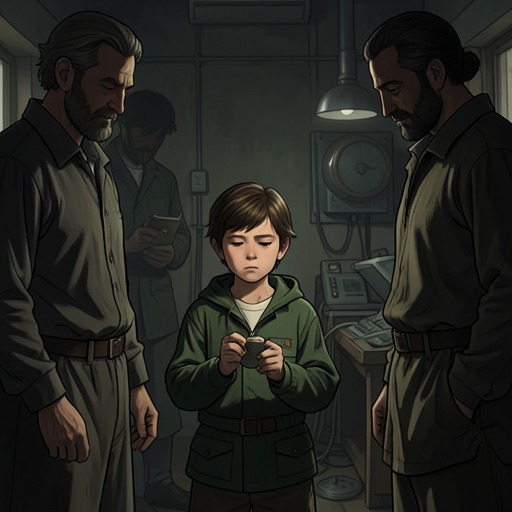
The victim is the one person you never know
In the WoodsThe expression The victim is the one person you never know captures a central limit of the investigation into Katy Devlin’s death: the person at its center is reconstructed from evidence and other people’s accounts, but cannot be fully recovered through them. Rob Ryan reflects that Katy had occupied less of his mind than the consequences of her death, and that the crime scene had eclipsed the life she had led before it. Her diary briefly interrupts that imbalance, giving her a voice of her own while also showing how much of her experience had remained inaccessible.
Meaning and Narrative Context
Rob Ryan formulates the expression after reading Katy’s diary, a year after her death and after the trial. Until then, he had known her chiefly through conflicting images supplied by other people. In the investigation, she had become inseparable from the place where her body was found and from the urgent chain of events that followed. The phrase does not mean that evidence is useless; it identifies the difference between establishing what happened and knowing a person in the fullness of her life.
The timing matters. The diary is read after the case has reached its legal conclusion, when Katy’s voice can no longer affect the investigation in the ordinary way. Rob Ryan admits that he had thought of her very little since the trial ended. The delayed encounter makes the expression both an observation about police work and a judgment on the narrative’s own attention: the victim can recede behind the crime, even when the crime is the reason everyone is looking for her.
Katy Devlin’s Diary
Katy’s diary covers almost eight months. Its early entries are regular and often concern ballet: instruction from Simone Cameron, rehearsal for a year-end performance, and Katy’s acceptance to the Royal Ballet School. The handwriting and entries present an individual life still developing—careful at first, then more distinctive, with excited writing when she receives the news about the school. These details give substance to a future and a set of interests that the investigation’s focus on her death had obscured.
Other entries record fear and conflict at home. Katy writes that Rosalind Devlin made her feel responsible for Jessica Devlin’s distress if she left for ballet school. She later records refusing a drink that Rosalind insisted she take, believing it made her ill, and describes Rosalind becoming angry and preventing Jessica from speaking to her. Katy also writes that her friends were turning away from her after Rosalind attributed hurtful remarks to her. The diary therefore complicates the more reassuring image of a happy, determined child: her excitement about dancing coexists with isolation, apprehension, and mistrust.
The diary also records Katy searching Rosalind’s room after her own diary went missing, finding it in a shoebox, and deciding to keep it at Simone Cameron’s home. Its final entry, dated three days before Katy died, softens the conflict: Katy accepts Rosalind’s apology and notes her promise to get a lucky charm for her dancing. That closing account does not erase the earlier entries; the movement from suspicion to reconciliation makes the diary an intimate but incomplete record, not a simple verdict on their relationship.
Testimony and the Limits of Mediation
The expression also fits the way other testimony reaches the investigators. Jessica Devlin makes a brief statement that a man had frightened Katy, but then withdraws into silence when asked to explain. Later, Rosalind begins to tell Rob Ryan what Jessica saw. He insists that Jessica must speak for herself if her account is to be admissible, because Rosalind’s version would be hearsay. The distinction is legally important, but it also exposes how easily a vulnerable person’s knowledge can be relayed, interrupted, or replaced by an adult’s account.
Sandra Scully’s experience reaches Rob Ryan through Cassie Maddox, who recounts Sandra’s repeated minimization of what had happened to her. The scene offers an account of harm, but not direct access to Sandra’s words or full understanding. Across these moments, information about victims and witnesses is shaped by who can speak, who is asked, and who is believed. The investigation needs testimony, yet testimony does not remove the distance between the person who experienced an event and those trying to understand it.
Evidence, Confession, and What Remains Unknown
Katy’s diary changes the emotional and interpretive picture, but it does not provide proof sufficient to establish a crime by itself. Rob Ryan recognizes that Rosalind could have offered an innocent explanation for the drink Katy mentioned, and that the promised charm did not directly connect Rosalind to an offence. The diary gives access to Katy’s suspicions and daily life; it does not settle every question raised by them. Its evidentiary limits sharpen the distinction at the heart of the expression: a fragment can be revealing without being complete.
The interrogation of Damien Donnelly presents a related problem from the other side of the case. Cassie Maddox argues that the killer may have been someone who did not want to kill, and Rob Ryan presses Damien to consider the consequences of keeping silent. Damien eventually acknowledges that their description resonates with him. Later, Rob Ryan confronts him with findings from the post-mortem and the discovery of the trowel, demanding an explanation for what he had omitted. The exchange produces disclosures, but its mixture of reassurance, pressure, and accusation does not make every aspect of Damien’s account transparent.
The expression therefore resists the idea that solving a case restores the victim to view. The diary brings Katy closer as a dancer, a friend, a sister, and a child weighing fear against hope, while the investigation establishes facts about her death. Neither kind of knowledge cancels the other, and neither turns her into a fully recoverable person. The phrase marks the ethical and narrative remainder: after evidence has been gathered and accounts compared, the victim’s life is still more than the case made from it.